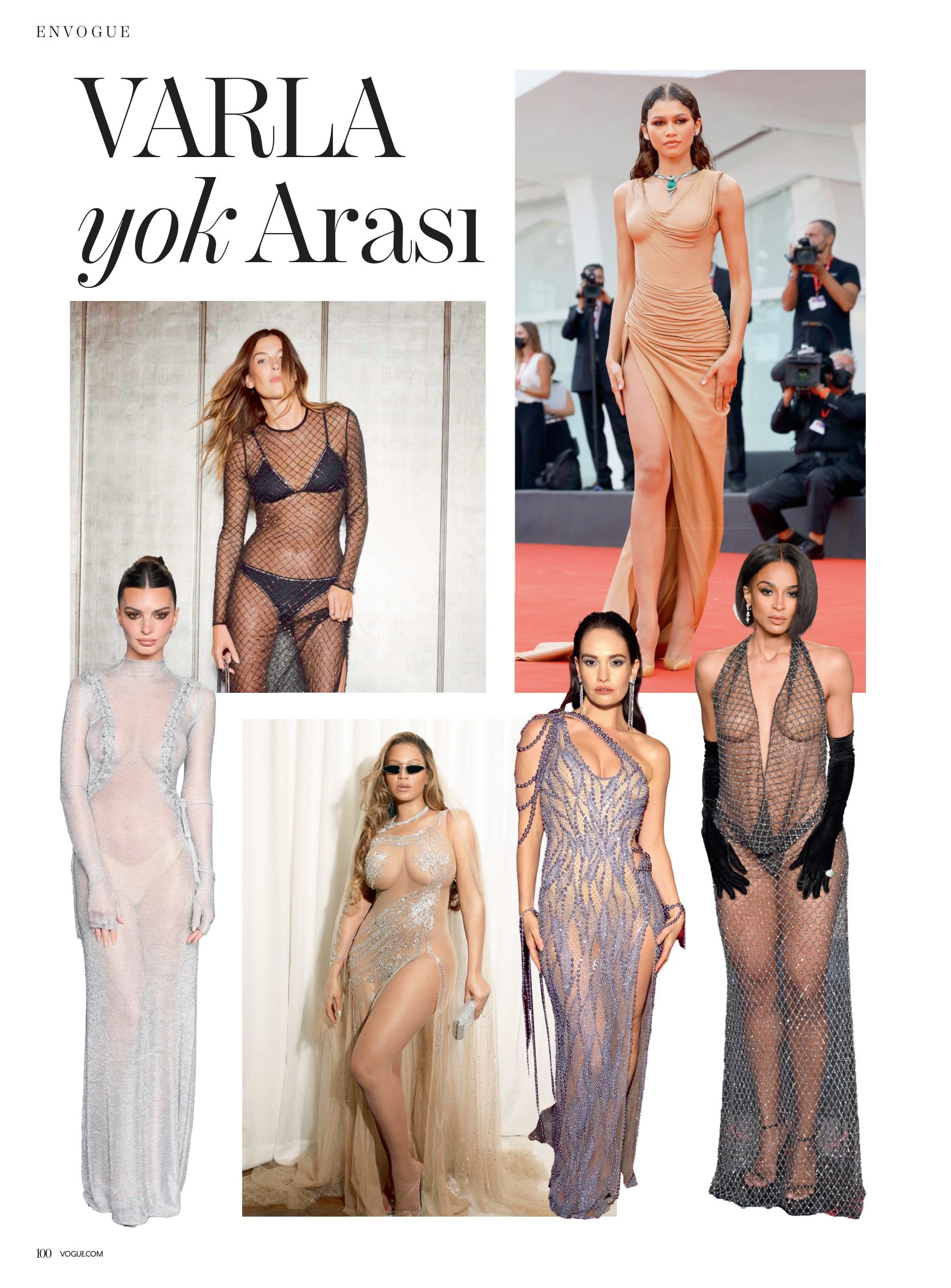
Not so long ago, if we spotted someone on the street, or even on screen, wearing a sheer, barely-there dress, we'd nudge whoever was next to us and stare in disbelief. Maybe we'd applaud their nerve, maybe we'd judge them. But times have changed. Sheer clothing, the "naked dress", is now on our screens, on the streets, and in stores. And more in demand than ever.
When journalists asked the legendary model and fashion icon Kate Moss about the sheer dress she wore to a party in 1993, she said she hadn't even noticed how transparent it was until the camera flashes went off; she only realised when she saw the photos. The dress that caused a scandal back then resurfaced thirty years later, and this time it wasn't a wardrobe accident. It had become a deliberate object of desire. And it's not just dresses anymore: sheer skirts, trousers, and tops are all part of the story.
To say the naked dress suddenly entered our lives out of nowhere wouldn't quite be accurate. From Katy Perry's Zuhair Murad gown at the MTV Video Music Awards to Beyoncé's Givenchy look at the 2015 Met Gala, sheer pieces had been making occasional appearances at award ceremonies and celebrity parties for years. But its recent rise isn't down to celebrities alone. It's driven by consumers who want to wear sheer clothing in their everyday lives, not just on special occasions. In Lyst Index's report for the second quarter of 2022, the naked dress from the Jean Paul Gaultier and Lotta Volkova collaboration, made using an illustration technique, ranked third among the most coveted items. Designer Julien Macdonald, whose daring, body-hugging gowns have been worn by the likes of Bella Hadid, has long been at the forefront of the naked dress trend. From Saint Laurent and Nensi Dojaka to fast fashion staples like Zara and Mango, sheer pieces are now everywhere, and no longer reserved for the celebrities and models we admire from afar.
One of the names most closely associated with the sheer look is Rihanna. Long before the naked dress had taken over our social media feeds, Rihanna showed up to the 2014 CFDA Fashion Awards in a sparkling, transparent dress that left little to the imagination, save for some flesh-toned underwear underneath (which she later told Vogue America was the biggest fashion mistake of her life). She continued to embrace the naked dress at events including Oscar after-parties, and didn't shy away from sheer looks even during her pregnancy. Rita Ora, Emily Ratajkowski, and Irina Shayk followed in her footsteps in the years that followed.
The naked dress making its way into everyday life is, in part, rooted in the women's rights protests of recent years. The #freethenipple hashtag, which gained momentum on social media in 2012, sparked a movement pushing back against the sexualisation of women's clothing. Supported by everyone from Kendall Jenner to Måneskin's Victoria De Angelis, the movement championed the idea that women should be able to wear what they want without having to conceal their sexuality. The movement also took aim at Instagram's censorship policies, drawing attention to the double standard of men going shirtless freely while women were judged and shamed for not wearing a bra. Meta's oversight board, which includes politicians and academics, put forward a recommendation to revise Instagram's censorship criteria, and a proposal calling for the platform's clothing policies to be overhauled in a way that doesn't discriminate based on gender, covering women, trans individuals, and non-binary people equally, was published on the board's website. The goal was simple: for everyone to have the freedom of self-expression that should be a basic right.
Despite all of this, there are still plenty of people who take issue with the idea of clothing that reveals the body beneath. Even though the naked dress is now a trend you can spot almost anywhere, it remains far from universally accepted. Women who wear it are frequently labelled immoral and accused of dressing for attention. Ciara, who attended the Vanity Fair Oscar after-party in a sheer dress, was reportedly declared "disrespectful" and compared to a stripper by the British Metro. Her husband Russell Wilson, who stood proudly by her side throughout the evening, was criticised for "not being man enough." Influencer Chiara Ferragni arrived at this year's Sanremo Music Festival in a naked dress aptly named the "Shameless Dress." Designed for Ferragni by Dior creative director Maria Grazia Chiuri, Ferragni explained on Instagram that she chose the dress as a reminder that women should be able to show their bodies however they wish, without judgement and without guilt. In her post, she wrote that she wore the nude-toned dress to free herself from the shame that is so persistently placed on women.
Sheer clothing is not about nudity. It's an act of defiance.
The naked dress isn't just about women being able to wear what they want freely and without judgement; it's also about being at peace with your own body. For years, women have been told to dress in ways that conceal their "flaws" according to beauty standards. The naked dress is a rejection of all that, a way of embracing every part of your body without apology. But sadly, many women are still on the receiving end of criticism for it. When Florence Pugh attended Valentino's Haute Couture show last year in a sheer dress, social media erupted with comments attacking both the dress and Pugh's appearance. She hit back on Instagram: "Why are you so scared of boobs? Small? Large? Left? Right? Only one? Maybe none? What. Is. So. Scary." The actress made clear that she had known she'd receive all kinds of reactions when she chose to wear the dress, and that she was entirely at peace with her body and had no intention of hiding it.
That's exactly what makes the naked dress trend so significant. Sheer clothing is not about nudity. It's an act of defiance: against the judgements placed on what we wear and how our bodies look, against the expectation that we cover up and conform. It's a declaration that our bodies are worthy of love, exactly as they are. As Kate Bowman, founder of the brand Kitten, put it to Women's Wear Daily: fashion should be about liberation, about self-expression and building confidence.